Showing posts with label books. Show all posts

Saturday, 14 May 2011

The bad news of infinite memory

From Challies' The Next Story
With the dawn of digital technologies and the massive cost decreases in storage, it has become more difficult to forget than to remember. ... Everything I've ever said or done on Facebook is recorded there forever; every search I've made on Google or Yahoo is there somewhere. It exists in digital memory.

Forgetting is a natural part of human experience and a natural function of the human brain. It is a feature, not a bug - one that saves us from being owned by our memories.

During the days of Communism in the Soviet Union, the KGB would stamp "to be preserved forever" on the dossiers of its political prisoners. The message was clear: the state did not and would not forget those who had betrayed her. And this shaped the people. It had to! They knew that what they had done in the past would always be held against them and at any moment could be used in prosecuting them. This is the message of our data today. What we say, what we do, the people we communicate with, the things we search for, the places we go - they are all stamped with "to be preserved forever." Our data never goes away. We can never change, never put on a new skin.

Through the long history of humanity, forgetting has been normal, and remembering has been the exception. But with today's digital technologies, the balance has shifted so that remembering is the default, and forgetting is the great exception. And can a world that never forgets be a world that truly forgives? Author Viktor Mayer-Schönberger asks, "If all our past activities, transgressions or not, are always present, how can we disentangle ourselves from them in our thinking and decision making? Might perfect remembering make us as unforgiving to ourselves as to others?"
Tim does point to some good news... but there's only so much you'll read in a blog post, so more tomorrow.

Friday, 13 May 2011

Where is the wisdom?

The endless cycle of idea and action,
Endless invention, endless experiment,
Brings knowledge of motion, but not of stillness;
Knowledge of speech, but not of silence;
Knowledge of words, and ignorance of the Word.
All our knowledge brings us nearer to our ignorance,
All our ignorance brings us nearer to death,
But nearness to death no nearer to GOD.
Where is the Life we have lost in living?
Where is the wisdom we have lost in knowledge?
Where is the knowledge we have lost in information?
The cycles of Heaven in twenty centuries
Bring us farther from GOD and nearer to the Dust. 
- From T S Eliot, 'The Rock'.

I am finding Tim Challies' (world famous Christian blogger) new book so very helpful: The Next Story: Life and Faith after the Digital Explosion
[It's also Christianaudio's free audio book this month - register and download - though if your taste's like mine, you'll want the hard copy or at least Kindle copy as well.]

Information is not knowledge, and even knowledge is not wisdom. Yet we train ourselves in a rushed search for information, and take little time to learn towards knowledge, and none to consider and reflect towards wisdom. 

What a contrast with our aspirations as Christian believers: 
And so, from the day we heard, we have not ceased to pray for you, asking that you may be filled with the knowledge of his will in all spiritual wisdom and understanding, so as to walk in a manner worthy of the Lord, fully pleasing to him, bearing fruit in every good work and increasing in the knowledge of God. [Colossians 1.9-10]

Monday, 4 April 2011

John Stott: A portrait by his friends

Those of my generation, outside of London and Anglican circles, could be forgiven for not knowing much of John Stott, his ministry and his legacy. But to continue in that ignorance would be foolish. The Lord used this servant more than any other one man, to influence Christianity in the UK (and possibly worldwide) in the 20th century - and therefore, also in the 21st. His books, preaching, CU missions, IFES involvement, London Institute of Contemporary Christianity (equipping Christians & churches for whole-life discipleship in the world), The Lausanne Movement (connecting evangelical leaders worldwide towards world evangelization, 'an exchange of gifts'), Langham Partnership ministry encouraging, training and equipping across cultural borders (especially global north-south), and his friendship and discipling of so many - more people have been edified through his ministry than realise it, if we consider the cascading effect. 

So for Stott's 90th birthday, IVP have brought out: John Stott, a portrait by his friends. They already have the two-volume TD-S biography, of course, which is well worth a read, and Roger Steer's recent and more brief Inside Story (a nice introduction). But if you just want the flavour of this man of God and some insights into how he was used - and why it would be of benefit to read his books, and those about him - then pick up John Stott: a portrait by his friends. It's not quite the 'warts and all' that he wanted, but doesn't completely descend into hagiography - there are still useful things to learn and much for which to praise God. 

(As it's a beautiful hardback, get it for your pastor / spiritual parent / ministry leader, as they'll surely appreciate it, and then borrow it to read yourself!) IVP have it on an introductory offer of £9.99 - as of 29-3-11, no note for how long.

I would have reviewed it, but Mark Meynell got in there first and said what I was going to.

Tuesday, 14 December 2010

Prefer to hear him roar!

One of the delights of a good novel is that you are welcomed in to a different world: for that short time, to breathe its air, to swim in its sea, and know its people. It is why I always suffered from an inclination to speak like Shakespeare's, Austen's, or (Pope's translation of) Homer's characters, when emerging from their books. The author invites you to see the world through different eyes: such is the power of words well set. 

Some books permeate so deeply that the effect is longer term. I revisited Narnia so much as a child (and teenager, and adult!), and then Malacandra and Perelandra, that our own Silent Planet took different meaning. It is as if a character from those worlds lent me their glasses, and now I see our own in fresh and sometimes strange hues. It is not simply that I love that world, but that I know this world, better. Having breathed that air, I can survive more ably here where the air is thinner.

Which is why I was so sad to read this article, which describes, with evident pity rather than trigger-happiness, how the creators of the recent Narnia films seem to have failed to taste Narnia's air, so found it strange, and have inadvertently replaced it with filtered air pumped in from our silent, twisted world. I'm sure they found it unrealistic - Miraz, Weston, are more like us, so we find the children stay like them rather than being transformed to be like the great Lion, the Son of the Emperor, who is not safe, but is good. 

Of course, Lewis was merely writing under the influence, himself. The influence of the Bible, which paints us into the ultimate reality, and gives us eyes to see and know its Painter. The loss of Narnia's oxygen in the films merely goes to illustrate that we need to draw on what is outside of ourselves to understand this world - not just revert to being true to ourselves. This world, and our hearts, does not have within it what we need to get through it alive. We need to breathe Narnian air*, and then we will find ourselves transformed by it.

Read Narnia Invaded, by Steven Bower.

* I mean, of course, its greater and perfect Idea and source. 

Friday, 17 September 2010

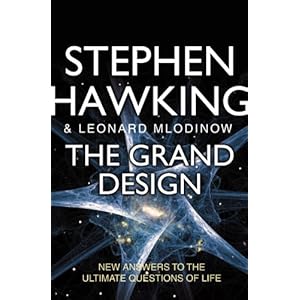
The Grand Design

The Grand Design - New answers to the Ultimate Questions of Life
[Or 'Old non-answers to the Ultimate Questions of Life']

It hit the headlines with, "'GOD IS DEAD,' says Prof. Hawkins." So is philosophy, apparently: Hawkins wants science to take over. Except that science deals with observation and experimentation, and he's talking about the beginning of the universe, which no scientist observed, and which cannot be repeated in a controlled experiment. So he does do philosophy after all, but badly. 
A: All swans I have seen are white
Therefore (by induction) all swans are white
= the law of this universe is such that swans are white 
The law of this universe makes swans white
Hm?
Scientific 'laws' are simply induction from observation. In other words, a 'law'of science merely describes what we see. It doesn't do anything, any more than the law of the jungle makes a snake eat a monkey. It describes the usual state of affairs. 

So for Hawkins and Mlodinow to imply that the law of gravity produced the big bang, is a severe category and logical error.

As for the ultimate questions of life... well, you don't get the right answers if you can't think of better questions: 42, anyone? 

For a more informed and detailed review, see Alexander Waugh in The Spectator, or The Economist's review.

A while ago, an Aussie paper reported:
"...not only are other planets likely to exist, but whole other universes, known collectively as the multiverse, are too, says Professor Hawking. If God's intention was to create mankind, then these many untouchable worlds would surely be redundant, he suggests."
Amen - God was not creating the universe just for the sake of man, with a gazillion redundant side projects that didn't quite work out, and one functional planet!
No, the God who communicated himself in Christ in all the Bible made the universe for himself, in an outward explosion of inter-trinitarian love. 'by [Christ]... through him, and for him.' The humanistic god-of-the-gaps we invent to be as man-centred as we are, is dead. Long live Christ, who is before all things, and in whom all things hold together!

Sunday, 22 August 2010

Quote of the Day: Talk to the Fool

'Are you in shadow? Are you in pain? Next to you, is Hamlet a happy man? ...

'Do not cry to me. I can only cry with you. I will not die for you. I am still too young in the meaning of love. Talk to the Fool, to the one who left a throne to enter an anthill. He will enter your shadow. It cannot taint Him. He has done it before. His holiness is not fragile. It burns like a father to the sun. Touch His skin, put your hand in His side. He has kept His scars when He did not have to. Give Him your pain and watch it overwhelmed, burned away by the joy He takes in loving. In stooping.'
- N.D.Wilson, from Notes from the Tilt-a-Whirl

Saturday, 14 August 2010

Puritans & prigs - reversed

Many people have read the best-seller novel Gilead. But author Marilynne Robinson is much more than a prize-winning novelist. With insight and a novelist's perception, she gives a fascinating interview with Michael Horton on Western culture and perspective, with topics ranging from Calvin as the best humanist, how Puritans weren't prigs, homelessness as a human condition, 'people struggle with forgiveness but God is capable of grace', and an author's definition of a good book. Worth hearing!

Sunday, 6 June 2010

Quote of the Day: A million more mirrors

In a perceptive review of Donald Miller's latest, A Million Miles in a Thousand Years, Chris Brauns praises Miller's vivid writing and use of story. "He told a story to teach about story and it really worked." I've been trying to do this increasingly - teach a poem poetically, a song tunefully, an image with imagination and imagery, and the drama of doctrine dramatically. Certainly Miller seems like an engaging writer. But as his engaging style and likeable personality resonate with us, Brauns is concerned that we'll all the more readily be pulled into his content, which will also resonate with us - naturally. His concern is that the stories are all about ourselves and our little lives, without much on God's big story enacted in history to give us hope and a future. Brauns comments:
We spend too much time looking at ourselves.  We don't need a million more mirrors all pointed back at our small stories.  Rather, we need to see how our individual episodes relate in a Christ-centered way to the story of creation, fall, and redemption.
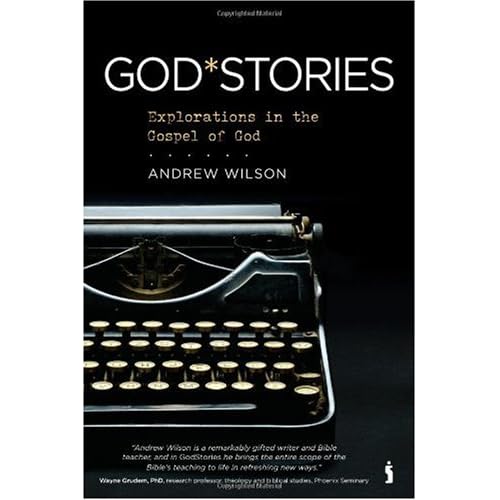
For a wonderfully clear and engaging use of story to communicate God's big story, do get hold of Andrew Wilson's God*Stories. I'm using it for church teen Bible class - but honestly anyone would benefit from it. Top writing, clarity, systematic & Biblical theology, in short chunks using Biblical stories. And that doesn't quite convey it. I picked up a colleagues copy when I was manning a stall at a summer youth festival last summer - and couldn't put it down, so that he lost it for the week, and I then bought several for myself and others.

Thursday, 1 April 2010

Timely new Driscoll title

I wish I'd spotted this earlier today - but a great new Driscoll book is out: Sweetheart. The review's worth reading.

Sunday, 28 February 2010

Symphonic Theology

Poythress' Symphonic Theology is a good little book - short chapters making an easy introduction to using various perspectives when reading the Bible: the validity, value and exemplification of the same. (That I enjoy reading Poythress is not entirely surprising, as he's a Presbyterian mathematician-theologian with an interest in linguistics and translation, and writes well.) I didn't so much find the book's ideas novel, as clarifying my thoughts. But I keep finding that if I think I've had a good idea, Poythress has already written a (much) better book on it. Next one I'm eager to get hold of is his new 'In the beginning was the Word: Language - A God-centred approach' from Crossway.

Friday, 11 December 2009

The Cross and Christian ministry

This book is marvellous. Not that Carson has an inovative powerful thesis of his own; he merely preaches 1 Corinthians, on the cross and Christian ministry. But God's word is powerful. Nor is that merely for the professional Christian minister: this is a message for all Christians who would in any way minister to others. And I know of no Christ-ian who would not serve others, given that our Master came among us as one who serves. So then, get it and read it. Ask for it for Christmas. It may have a bad cover, but it's worth every penny, and it's short & easy to read, too - incredibly, for the riches of it. I've been fitting it in in lunchbreaks at work.

Wednesday, 21 October 2009

Quote of the day: blasphemy & treason!

But why a trial at all? Was it only a pretext to get rid of Jesus? Why not hire a hit man, or arrange a secret poisoning? Surely this would have achieved the same result? But God decreed otherwise. As Christ stood on trial in our place, these particular charges had to be brought. In Revelation 20:11-15 we see the great white throne at the final judgment; here the books are opened. This is the trial which awaits all who have not put their trust in Jesus Christ, as their substitute and sin-bearer, all whose names are not written in the Lamb’s Book of Life.
The two charges against Christ, blasphemy and treason, are the very charges against the whole human race. In every sense, he stood in for us, and bore what was ours, and gave us what was his.
- The Glory of the Cross, by James Philip

Friday, 7 August 2009

Slave of Christ

On recommendation, I read Harris' Slave of Christ on holiday, and now heartedly recommend it also. In our culture, we tend to be wary of using slavery to describe our relationship with God: when we think of slavery, we think of non-personhood and of dreadful mistreatment of humans by others.

Harris examines the Biblical evidence to show that the imagery of slavery is pervasive in Scripture, and that ultimately, we are slaves of Christ. Most of our English translations have softened it to servants, but the idea of slavery is very much there. Why slavery? It denotes complete ownership, command, protection and dependence (rather than autonomy). The slave must obey his Master's commands, and also seeks to please his Master.

I once attended a seminar taken by a leading Christian apologist to Muslims, who made the case that while in Islam the primary man-God relationship is that of slave, in Christianity we don't see ourselves as slaves of God. But this isn't the contrast that the NT makes. We are slaves - in fact, everyone is a slave to whatever masters him, as Peter wrote. So becoming a Christian is gaining a new master - Jesus is Lord! The difference with Islam is not that we do not see ourselves as God's slaves, but that we are slaves of the living and true God who revealed himself in Christ,
who, though he was in the form of God, did not count equality with God a thing to be grasped, but made himself nothing, taking the form of a slave, being born in the likeness of men. And being found in human form, he humbled himself by becoming obedient to the point of death, even death on a cross. [Phil.2]
As Horatio Bonar's hymn asks, "It is the way the Master went: should not the servant tread it still?" We are not slaves of an arbritrary and capricious despot who only insists at length in writing that he is merciful: we are slaves of the one who came and was among us as one who serves, to give his life to purchase us for God. And that makes all the difference!

There are Scriptural limitations in the metaphor of slavery: Harris considers being friends of Christ, who are given revelation of his business, and adopted co-heirs of Christ. But we mustn't simply reject the image because it's not comfortable to us. As Christ's, we are his slaves, owned totally by Him, to obey Him fully and to live to please Him.

This may be despised by men, as if we might as well be dead, as live in slavery to a Master, following His will and living to please Him. But that's the point: I have been crucified with Christ: it is no longer I who live, but Christ who lives in me, and the life I now live in the flesh I live by trusting in the Son of God, who loved me and gave Himself for me. [Gal.2] What a joy and privilege!

Thursday, 23 July 2009

Quote of the day: be afraid

'Sometimes people ask us if we're scared, living in the inner city,' say Shane Claiborne and Jonathan Wilson-Hartgrove. 'We usually reply with something like, "We're more afraid of shopping malls." The Scriptures say we should not fear those things which can destroy the body, but we are to fear that which can destroy the soul (Matthew 10.28).'
Paul Tripp says: 'Jesus demands everything, not just so we would submit to his control, but to free us from the control of things that were never designed to control us.'
[...]
Someone mentioned on the phone to me recently the death from cancer of a prominent Christian leader in his fifties. She described it as a tragedy. But his death wasn't a tragedy. It was certainly a loss to his family, friends and the wider church. But it wasn't a tragedy. It was gain. Let me tell you what is a tragedy: Someone who gets a good education, secures a well-paid job, buys a house in a nice area, marries and has children, and ensures his children get a good education, so the cycle can begin again. Someone who treats Christ as a hobby or an insurance against hell. Someone who leaves behind and rusting car and children who've been trained to be self-indulgent. Someone with no gospel legacy. That's the tragedy.

[...]
  • What did you do yesterday for your present comfort or security? What did you do yesterday for God's future?
  • What did you do last week because you saw an advert or you saw something someone else had? What did you do last week because of your confidence in God's promises?
  • What will you do tomorrow to store up treasure on earth? What will you do tomorrow to store up treasure in heaven?
  • When did you last take a risk for God? What did you risk?
  • Hebrews 11.25 says the pleasures of sin last only for a short time. Psalm 16.11 says that at God's right hand 'are eternal pleasures'. What gives you pleasure? Is that pleasure fleeting or forever?
  • Death separates us from every source of happiness except Jesus. Can you say with Paul that 'to die is gain' (Philippians 1.21) because Jesus is your ultimate joy?
  • What about big life decisions you've made? Your job? Your home? Your relationships? Did you make them on the basis of God's promises for the future?
  • What about the decisions you're facing now? What would it mean to make them on the basis of God's promise for the future?
[Tim Chester, in The Ordinary Hero - living the cross and the resurrection.]

Friday, 29 May 2009

Creation regained

I've enjoyed reading Wolters' Creation Regained in our staff study programme. It's a great call to a reformation wordview, rather than an all-too-gnostic division of world into sacred and secular. He helpfully gives categories of structure and direction, with which to analyse - structure is what we might think of as substance, material (whether physical or not); direction is essentially how it's used or acted upon - in conformity to God's good creation or in a distortion or perversion of it? This thinking prevents us from throwing good babies out with bad bathwater, or from drinking dirty bathwater just because sometimes it's useful for cleaning babies.

However there seemed to me to be a drawback with the book - a looming absence. It might have been because of the subject material, but God seemed rather distant. Impersonal. His power acts in Jesus Christ by the Spirit to transform the world. He's Trinitarian in formula: "God is renewing the creation and the whole of human life in the work of Jesus Christ by the Spirit." Yet somehow this comes across as impersonal. It's a project to renew creation and human life. To this end Jesus defeats sin and evil in his death and resurrection. But what about, "Eternal life is to know you, the one true God, and Jesus Christ whom you have sent"?

There is a problem when salvation is reduced to the realm of personal communion with God, and our role as God's glory - his image-bearers, his vice-regent representatives of his rule over creation under him - is forgotten. But we mustn't neglect the place of personal reconciliation as well as cosmic: of not only restoring creation but knowing God as Father in Christ by the Spirit. God's Kingdom is not merely that God is renewing the creation and the whole of human life in the work of Jesus Christ by the Spirit. The good news of God's kingdom includes the announcement of how one may take part in this kingdom in repentence and faith - i.e., how this kingdom's arrival is indeed good news for you! And that involves the Trinity covenanting together to call and provide a way for us to come to Himself. And it centres on a cross and empty tomb. Not merely a place of victory over evil, but a victory over evil because it is place of satisfaction of God's justice, of taking of his curse on creation on himself, so that we who were once not only failed-caretakers but hostile are reconciled by his blood.

I'm not writing off the book for that - on the contrary, it's a clear and persuasive introduction to its stated topic. But when the authors have taken the opportunity of a second edition to write a postscript describing the gospel more broadly than their remit, it was disappointing that they didn't bring in this glorious personal aspect, indispensible for their topic.

Perhaps I'm being unfair, on a first reading. It got me thinking, though, of this null hypothetical: Say you had reformed all of life - church, family, politics, business, art, education, journalism, thought, emotion, plants and animals, inanimate matter - in a Godward direction, so that, by God's power in the work of Christ by the Spirit, it was as it should be in God's good creation. And you did not know the Father in Christ. Would you be happy? Would you have fulfilled the gospel? The kingdom? (It's an impossible hypothesis, of course, but perhaps worth pondering.)

Friday, 17 April 2009

Orbitting Narnia

BBC documentary here looking into an idea that C.S.Lewis used ideas from mediaeval cosmology in each of his Narnia Chronicles. Given that Lewis was a professor of ancient and mediaeval literature, and had a fascination with mythology and the planets, this would seem to me to fit. It comes out clearest in his cosmic trilogy, not only in Ransom's visits to other planets, but in the characteristics of those planets (our 'Mars' and 'Venus'), and in the last of the trilogy, in the gods descending to earth like Plato's ideals taking shape.

The theory explains why Lewis breaks the laws of a fantasy world by inserting Father Christmas into The Lion, the Witch and the Wardrobe, for example. Knowing the Chronicles practically by heart (I've a wonderful mother who read them to us on Sunday afternoons, and later I recall reading Price Caspian 6-8 times in one year), I find it a compelling theory.

What I don't like is the hype of calling this a code, to unlock Narnia. It isn't a code, showing a deeper meaning. It merely helps us see Lewis' thought behind some of the ideas he put in the stories, to appreciate his thought rather than dismissing it as random. As such, it's wonderful to appreciate Lewis' brilliance more.

Why not delve into Lewis' essays on literature, or other works? I do esteem his last novel, 'Til We Have Faces, as the best fiction he wrote. It masterfully weaves together his love for classics, for myth, for apologetics, and his incredible writing skill - simply marvellous! And beautiful. Lewis himself said it was one of his favourite works.

Tuesday, 14 April 2009

Finally Alive!

John Piper's recent title Finally Alive [Christian Focus Publications in UK] is excellent on what it means to be born again - that strange term oft misunderstood, and abused as a socio-political referent! I was partway through reading it when someone said to me in an unrelated conversation, "After all, Jesus gave grounds for belief in reincarnation - he said you must be born again." Piper goes through John 3 and also most of 1 John, and other passages, to show what Jesus meant by being born again, and how vitally necessary it is. It won't do to not be one of those "born again" types. Otherwise, we're dead, unable to do anything for ourselves before God because we refuse to see Christ in His beauty and authority, and seek after other things which kill, steal and destroy. He has come that we may have life! I wouldn't say it's an easy read - not a tract to hand a friend, but someone who is prepared to apply themselves to understanding it. But he does a great job of showing the importance of being born again, what it is, what God does and what we must do.

God's heart and ours

The latest Theologynetwork table talk is out and well worth a listen: Mike Reeves in conversation with Ron Frost about Richard Sibbes, God as Father and our hearts. Not to be restricted to the table - this is to be taken outside and enjoyed, in a family walk (below)! Sibbes' The Bruised Reed is my current train / flight reading, interspersed with Owen on the Mortification of Sin: highly recommended!

Wednesday, 4 March 2009

The headless monster (or our primary loyalty)

As you could tell from previous posts, I've been enjoying G.K.Chesterton's Orthodoxy. Yet as I've progressed through it, and especially in the chapter, "The Flag of the World," it has struck me increasingly as horribly man-centred. He writes with such power and wit that it's hard not to be carried along by it - but he seems to have Man as supreme. He speaks of how we must have a "primary loyalty to life" (or to 'the universe') - to love it enough to feel its strangeness and yet set about changing it. He speaks of suicides as insulting the creation by 'refusing to live for its sake.' This is true, but not ultimate: we insult God by refusing to live for Him!

But that is idolatry and adultery. We are first to love the Lord our God with all our heart, soul, mind and strength, and then men as we love ourselves: but this feels like we are forgetting the Creator and loving His creation primarily, instead.

So much of what Chesterton says is true, but it falls short. He speaks of the accomplishments of the Church, as if of Christ - but without reference to Him. Now we would say, rightly, that one cannot speak of the Bride of Christ without implicating Him - but what a monstrous thing to speak of a body without its head, a bride always without her bridegroom. "Can the lion lie down with the lamb and still retain his royal ferocity? That is the problem the Church attempted; that is the miracle she achieved." How dare one speak of this as a work of the Church, rather than a glory of God in Christ?

GKC speaks strikingly of the eternal nature of truth, and the importance of doctrinal correctness: helpful in an age which prefers fashion in doctrine, and would rather fluffy feeling than theological precision. But the goal he places before us is human happiness: "...if some small mistake were made in doctrine, huge blunders might be made in human happiness." This is true, but it falls short: our ultimate goal in doctrine is not as a means to the end of human happiness, but faithfulness to the glory of the one true God, who has revealed Himself to us in the one who is Truth, Christ!

Chesterton lambastes selfish egoism, but he doesn't go far enough. He speaks of Christianity, but not of Christ. When he is at his most sparkling, there is a dullness brought by this, that he speaks of Christianity over Christ, Church over Christ, and Man's happiness over God's glory.
Of all horrible religions, the most horrible is the worship of the god within. ... Christianity came into the world firstly in order to assert with violence that a man had not only to look inwards, but to look outwards - to behold with astonishment and enthusiasm a divine company and a divine captain.
So true, yet not consistent with the rest, where he merely turns our attention from 'the light within' to Man as a whole, rather than to God. It is not then surprising that earlier in the work he explains how he came up with his own, natural, theology, and then found that it "had been discovered before, by Christianity." But true Christianity is no man-made philosophy - such a thing does tend to have Man as its goal, with God in service. Christ came to reveal God - quite another dynamic.

Perhaps in the final few chapters (for I have committed the cardinal error of critiquing a book before I've finished reading it) he will correct this blasphemous tendency. But for now, let me leave you with Calvin's main contention with Cardinal Sadolet, who was trying to persuade Genevans back into the fold of Rome:
It is not very sound theology to confine a man's thoughts so much to himself, and not to set before him, as the prime motive of his existence, zeal to illustrate the glory of God. For we are born first of all for God, and not for ourselves. As all things flowed from him, and subsist in him, so, says Paul, (Romans 11:36,) they ought to be referred to him. I acknowledge, indeed, that the Lord, the better to recommend the glory of his name to men, has tempered zeal for the promotion and extension of it, by uniting it indissolubly with our salvation. But since he has taught that this zeal ought to exceed all thought and care for our own good and advantage, and since natural equity also teaches that God does not receive what is his own, unless he is preferred to all things, it certainly is the part of a Christian man to ascend higher than merely to seek and secure the salvation of his own soul.

I am persuaded, therefore, that there is no man imbued with true piety, who will not consider as insipid that [Sadolet's] long and labored exhortation to zeal for heavenly life, a zeal which keeps a man entirely devoted to himself, and does not, even by one expression, arouse him to sanctify the name of God. But I readily agree with you that, after this sanctification, we ought not to propose to ourselves any other object in life than to hasten towards that high calling; for God has set it before us as the constant aim of all our thoughts, and words, and actions. And, indeed, there is nothing in which man excels the lower animals, unless it be his spiritual communion with God in the hope of a blessed eternity.
(Jean Chauvin,
Response to Sadolet, 1539.)

Sunday, 1 March 2009

Quote of the day: misplaced humility

"It is impossible without humility to enjoy anything - even pride.

"But what we suffer from today is humility in the wrong place. Modesty has moved from the organ of ambition. Modesty has settled upon the organ of conviction; where it was never meant to be. A man was meant to be doubtful about humself, but undoubting about the truth; this has been exactly reversed. Nowadays the part of a man that a man does assert is exactly the part he ought not to assert hiumself. The part he doubts is exactly the part he ought not to doubt - the Divine Reason. Huxley preached a humility content to learn from Nature. But the new skeptic is so humble that he doubts if he can even learn. [...]

"Every day one comes across somebody who says that of course his view may not be the right one. Of course his view must be the right one, or it is not his view. We are on the road to producing a race of men too mentally modest to believe in the multiplication table. We are in danger of seeing philosophers who doubt the law of gravity as being a mere fancy of their own."
- G K Chesterton, The Suicide of Thought, in Orthodoxy, 1908.

I'm not sure that this misplaced humility is actually humility - indeed, I'm sure that in moving humility, it destroys it, and I think Chesterton is getting at that. But how deceitful our hearts, that we misplace humility and are proud of it. I'm not sure whether GKC saw that coming - that we boast that we cannot know, should not know, and do not permit others to know. Hence the assumption, that if you tell someone some news as truth, you must be arrogant. "Aren't Christians arrogant to claim to know the truth?" Humility is found in ambition, Chesterton would reply - knowing that we are so small that we delight in bigger things. It isn't found in claiming that we can know nothing. When we say that we know the truth as Christians, we point to ourselves as small, that there is something bigger, more exciting, more dependable, more worthy. That is humility. Or as the apostle Paul said, "What we proclaim is not ourselves, but Christ Jesus as Lord, and ourselves as your slaves for Jesus' sake." [2 Corinthians 4]