Showing posts with label Christ. Show all posts

Sunday, 19 June 2011

4. We love God the Son

Continuing with The Cape Town Commitment - on this Lord's Day:

God commanded Israel to love the LORD God with exclusive loyalty. Likewise for us, loving the Lord Jesus Christ means that we steadfastly affirm that he alone is Saviour, Lord and God. The Bible teaches that Jesus performs the same sovereign actions as God alone. Christ is Creator of the universe, Ruler of history, Judge of all nations and Saviour of all who turn to God.[14] He shares the identity of God in the divine equality and unity of Father, Son and Holy Spirit. Just as God called Israel to love him in covenantal faith, obedience and servant-witness, we affirm our love for Jesus Christ by trusting in him, obeying him, and making him known.

A    We trust in Christ. We believe the testimony of the Gospels that Jesus of Nazareth is the Messiah, the one appointed and sent by God to fulfil the unique mission of Old Testament Israel, that is to bring the blessing of God’s salvation to all nations, as God promised to Abraham.
  1. In Jesus, conceived by the Holy Spirit and born of the Virgin Mary, God took our human flesh and lived among us, fully God and fully human.
  2. In his life Jesus walked in perfect faithfulness and obedience to God. He announced and taught the kingdom of God, and modelled the way his disciples must live under God’s reign.
  3. In his ministry and miracles, Jesus announced and demonstrated the victory of the kingdom of God over evil and evil powers.
  4. In his death on the cross, Jesus took our sin upon himself in our place, bearing its full cost, penalty and shame, defeated death and the powers of evil, and accomplished the reconciliation and redemption of all creation.
  5. In his bodily resurrection, Jesus was vindicated and exalted by God, completed and demonstrated the full victory of the cross, and became the forerunner of redeemed humanity and restored creation.
  6. Since his ascension, Jesus is reigning as Lord over all history and creation.
  7. At his return, Jesus will execute God’s judgment, destroy Satan, evil and death, and establish the universal reign of God.
B    We obey Christ. Jesus calls us to discipleship, to take up our cross and follow him in the path of self-denial, servanthood and obedience. ‘If you love me, keep my commandments,’ he said. ‘Why do you call me Lord, Lord, and do not do the things I say?’ We are called to live as Christ lived and to love as Christ loved. To profess Christ while ignoring his commands is dangerous folly. Jesus warns us that many who claim his name with spectacular and miraculous ministries will find themselves disowned by him as evildoers.[15] We take heed to Christ’s warning, for none of us is immune to such fearful danger. 

C    We proclaim Christ. In Christ alone God has fully and finally revealed himself, and through Christ alone God has achieved salvation for the world. We therefore kneel as disciples at the feet of Jesus of Nazareth and say to him with Peter, ‘You are the Christ, the Son of the Living God,’ and with Thomas, ‘My Lord and my God.’  Though we have not seen him, we love him. And we rejoice with hope as we long for the day of his return when we shall see him as he is. Until that day we join Peter and John in proclaiming that ‘there is salvation in no one else, for there is no other name under heaven by which we must be saved.’ [16]
We commit ourselves afresh to bear witness to Jesus Christ and all his teaching, in all the world, knowing that we can bear such witness only if we are living in obedience to his teaching ourselves. 

Friday, 29 April 2011

Wedding prep

The royal wedding was beautiful. It brought an unexpected tear to my eye as I was reminded of the greater future wedding of the once and future King, when every eye will see him. (Broadcast entirely funded by the Father, freeview.) 

The guest list is set, though we're still waiting for everyone to arrive - coming from far more countries than the Commonwealth. It's all been catered for. The choir's booked, the anthem written, and the processional fanfare has some marvellous words. People have been lining the streets waiting for a long time. It's no secret what we'll be wearing - it's been provided by the Father of the groom!

I was so disappointed that the sermon at William and Catherine's wedding contained so much truth, but didn't point to Christ. It began well: 'You have chosen to be married in the sight of a generous God, who so loved the world, that he gave himself to us in his Son.' But the general sentiment of the address seemed to be that with God's help we all evolve spiritually into the creation of the better world to which we look forward. The speaker missed why we need a self-giving God - not just as an example for marriage, but that we can't bring about a better world with just a bit of divine help. That's why Jesus died, rose and is coming again.
Hint: you know there's something skewed about a wedding address if Jesus' redemption of his bride, 
and return to consummate his new creation, is lacking. (Actually, you know there's a lot wrong with any Christian sermon if Jesus and his finished redeeming work is conspicuously absent.) 

We had the good of marriage upheld, but none of the beauty of Christ, and there's something very wrong about that. 
Husbands, love your wives, as Christ loved the church and gave himself up for her, that he might sanctify her, having cleansed her by the washing of water with the word, so that he might present the church to himself in splendour, without spot or wrinkle or any such thing, that she might be holy and without blemish. In the same way husbands should love their wives as their own bodies. He who loves his wife loves himself. For no one ever hated his own flesh, but nourishes and cherishes it, just as Christ does the church, because we are members of his body. “Therefore a man shall leave his father and mother and hold fast to his wife, and the two shall become one flesh.” This mystery is profound, and I am saying that it refers to Christ and the church. However, let each one of you love his wife as himself, and let the wife see that she respects her husband. [Eph.5.25-33]
For the good of the married couple; for the blessing of every one of the x million listeners, viewers and those attending; they should have been told that it's not ultimately about them. 
  • That although this day is for celebrating their union, it points to the union of Christ and his bride. 
  • That although Prince William is, we trust, a future king, he is eclipsed in every way by the King of kings, Jesus. 
  • That while Catherine was beautifully radiant in her dress, the betrothed of Christ is going to be spotless and peerless. 
  • They have vowed to be united, 'Until death us do part,' yet there is a greater promise, which defeated death. 
  • While they are caught up into each other's presence, the royal family, and the palace, there is a better presence, a greater family, and a palace beyond all imagining. 
Then I saw a new heaven and a new earth, for the first heaven and the first earth had passed away, and the sea was no more. And I saw the holy city, new Jerusalem, coming down out of heaven from God, prepared as a bride adorned for her husband. And I heard a loud voice from the throne saying, “Behold, the dwelling place of God is with man. He will dwell with them, and they will be his people, and God himself will be with them as their God.  He will wipe away every tear from their eyes, and death shall be no more, neither shall there be mourning, nor crying, nor pain any more, for the former things have passed away.” [Rev.21.1-4]
The crowds lining the roads merely to cheer, indicated how much we want to participate in such a glorious event. Far more can we look forward to participating gloriously in the Wedding of all history. Just make sure you don't ignore, forget or slight the invitation - or think you can get in on your own merits.

With words of Luther: 
Christ, that rich and pious husband, takes as a wife a needy and impious harlot, redeeming her from all her evils and supplying her with all his good things. It is impossible now that her sins should destroy her, since they have been laid upon Christ and swallowed up in him, and since she has in her husband Christ a righteousness which she may claim as her own, and which she can set up with confidence against all her sins, against death and hell, saying, "If I have sinned, my Christ, in whom I believe, has not sinned; all mine is his, and all his is mine," as it is written, "My beloved is mine, and I am his" (Cant. ii. 16).

Wednesday, 20 April 2011

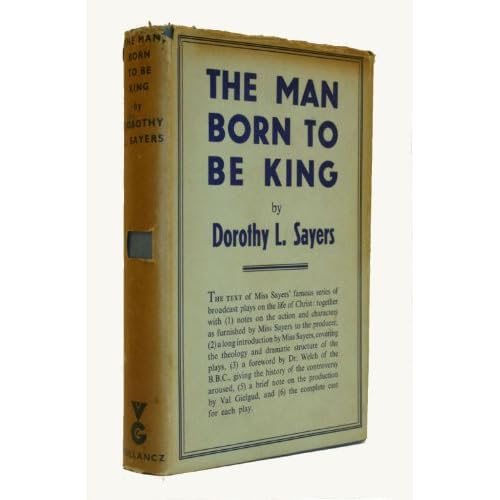
The Man born to be King

Dorothy Sayers' radio plays on the life of Christ, are currently being played on BBC radio 4 extra - an interpretation of the Scriptural gospels, a creative account. I don't really know why it was so controversial when first broadcast; I'm delighted to hear something so strongly based on the Biblical narrative. 

Herod: 'You cannot rule men by love. When you find your King, tell him so. Only three things will govern a people: fear, and greed, and the promise of security. ... Wherever I love, I find treachery. Love is a traitor, it betrays all kings. It will betray your Christ.'

The first episode is available until Tuesday 26th April: Kings in Judea.

Saturday, 6 March 2010

Awe-inspiring irony

Tonight I had the privilege of hearing the CBSO, CBSO Chorus and soloists, conducted by Sir Simon Rattle, perform Bach's St Matthew Passion. I'd been reading Carson's Scandalous on the way - here follow a few selections from the libretto, and then some verse by Carson.
The Saviour falls prostrate before his Father,
And so he raises me and all men from our fall
Up again to God's grace
He is ready
To drink the cup of bitter death
In which the sins of the world were infused, stinking;
Because it pleased God.

How awe-inspiring is this sentence:
The good shepherd suffers for the sheep.
The debt he pays: the Master;
he the righteous, for his servants.

Why, what evil has this man done?

He has so richly blessed us all:
To the blind he has given sight,
The lame he made to walk,
He told us his Father's word,
He drives the devil forth,
The humble he has lifted up,
He took the sinners to himself.
Else, my Jesus has done nothing.

Out of love,
For love now will my Saviour die:
He does not know a single sin.
That eternal condemnation
And the sentence of the court
Will not fall upon my soul.

Ah Golgotha, unhappy Golgotha!
The Lord of majesty must perish here, scorned,
The saving blessing of the world
Is placed as a curse upon the cross.
Creator of both earth and heaven
From earth and air must now be taken.
The guiltless must die guilty here.

See - Jesus has outstretched his hand
To capture us
Come! Where to? To Jesus' arms.
Seek redemption: take his mercy.
Where? In Jesus' arms.
Living, dying: rest here,
You forsaken little chicks:
Stay. Where? In Jesus' arms.

And, behold: the curtain of the temple was rent in two from the top to the bottom. And the earth was filled with quaking, and the cliffs split asunder, and the graves themselves opened up, and there rose up the bodies of many saints who were sleeping, and they came out of the graves after his resurrection and came into the holy city and appeared to many. But the centurion and those who were with him and were watching over Jesus, when they witnessed the earthquake and all that there occurred, were terrified and said: Truly, this was the Son of God.
And Carson's verse, from Scandalous
On that wretched day the soldiers mocked him,
Raucous laughter in a barracks room,
'Hail the king!' they sneered, while spitting on him,
Brutal beatings on this day of gloom.
Though his crown was thorn, he was born a king -
Holy brilliance bathed in bleeding loss -
All the soldeiers blind to this stunning theme:
Jesus reigning from a cursed cross.

Awful weakness mars the battered God-man,
Far too broken now to hoist the beam.
Soldiers strip him bare and pound the nails in,
Watch him hanging on the cruel tree.
God's own temple's down! He has been destroyed!
Death's remains are laid in rock and sod.
But the temple rises in God's wise ploy:
Our great temple is the Son of God.

'Here's the One who says he cares for others.
One who says he came to save the lost.
How can we believe that he saves others
When he can't get off that bloody cross?
Let him save himself! Let him come down now!' -
Savage jeering at the King's disgrace.
But by hanging there is precisely how
Christ saves others as the King of grace.

Draped in darkness, utterly rejected,
Crying, 'Why have you forsake me?'
Jesus bears God's wrath alone, dejected -
Weeps the bitt'rest tears instead of me.
All the mockers cry, 'He has lost his trust!
Here's defeated by hypocrisy!'
But with faith's resolve, Jesus knows he must
Do God's will and swallow death for me.

Thursday, 19 November 2009

The irony of saying there is no God

I was watching a Horizon programme which I'm told will be interesting on linguistics, which I find fascinating. But I've just stalled on the opening premise, which is the complete mystery of how humans uniquely have the innate ability to speak! "How did this ability evolve? Why is it uniquely human?" "When you start to think about it, it seems miraculous!" "We know an enormous amount about the first few fractions of a second at the commencement of the universe, but we really know very little at all about what makes us human and where language comes from."

There's an elephant in the room. He's called the Word. We're made in His image. In the image of a God who spoke and the universe happened. We're his testimony to the rest of creation, to the animal kingdom, of who he is - truth in community, the one who speaks graciously to make covenants which depend entirely on his speech-action, the one whose words always does exactly what he sends it to do. He breathed into us his breath, and we became different to the animals. We speak, we communicate, we commune. We are in the image of the God who is self-revelatory community.

We have rejected the author of our speech, the Word, so our speech is frustrated, and we mis-communicate and lie. We have refused the one who spoke in self-giving love to build the universe, and we use words to hate and murder rather than to love and build up. We are like the talking animals C S Lewis portrayed in
The Last Battle: we refuse to worship the Word, the one who gave us his breath, so we become dumb. So when he wanted to redeem us to restore that image, the Father sent the Word, who took the lies, the mocking, the murder, and the broken communication of silence into his very heart, so that together they breathed again into us, dumb and bestial as we are, to give us his Spirit.

"How did this ability evolve? Why is it uniquely human?"
"When you start to think about it, it seems miraculous!"


Sometimes it really seems like we're sitting in a room, chatting, and asking aloud, "Why is this room so cramped? How did it become so dark and smelly in here?" "It seems almost miraculous!" But above all, let no-one whisper that there may be an elephant in the middle of the room. That's not scientific; we don't believe in elephants.

As C S Lewis said, "I believe in Christianity as I believe that the sun has risen, not only because
I see it, but because by it I see everything else." But for 'Christianity', replace it with Christ himself, the Word, and the one the universe is bursting to reflect and praise.
"From the mouth of babies and infants you have ordained praise, to silence the enemy."

Friday, 23 October 2009

Quote of the day: bursting with thanksgiving!

“To be bursting with thanksgiving is a true witness of the Spirit within us. For the voice of thanksgiving speaks without ceasing of the goodness of God. It claims nothing. It sees no merit in man’s receiving but only in God’s giving. It marvels at his mercy. It is the language of joy because it need look no longer to its own resources.

The Christian rejoicing in this blessing of a thankful heart will have his eyes fixed upon the right person and the right place, Christ at God’s right hand. He cannot be taken up with himself without being immediately reminded that everything he possesses is the gift of God.”

R.C. Lucas, The Message of Colossians and Philemon

Friday, 16 October 2009

Not faith, but Christ

"Why should I let you into my heaven?"

Clue: the answer does not begin, "Because I..."

I’ll bow and be silent. Then I’ll hear a voice,
“Father, he’s mine.”

Do you see? It’s not your faith that saves. It’s Christ.

Read the rest of Glen Scrivener's helpful post.

Monday, 7 September 2009

Quote of the day: the purpose of redemption

The purpose of creation, redemption, and consummation are seen holistically as God’s purpose to glorify Christ by fulfilling the Adamic creation mandate, the universal Noahic promise, the patriarchal covenants, and the Israelite monarchy in Him, thus exalting Jesus as preeminent over the entire cosmos as the agent of creation, the true imago Dei, the Davidic subjugator of all rival powers, the firstborn of the eschatological resurrection from the dead, and the atonement through whom final cosmic peace is found at last (Col. 1:15-23).

- Russell D. Moore, The Kingdom of Christ (Wheaton, Ill.: Crossway Books, 2004)

[HT: Of First Importance]

Sunday, 30 August 2009

Christ the key and cornerstone

I've been pondering lately a couple of key critiques, which are actually one. A friend in church said of a children's talk of late, that a Muslim would've been happy with it. My Mum would sometimes critique a service, that a (non-Messianic) Jew would've been happy with it. It may sound extreme rhetoric, but passing over whether or not these critiques were true in those instances, it is the key critique. What does our service, what does the talk, what does our church life, make of Christ? If the good news of Jesus Christ weren't true, would the talk still hold? It shouldn't! The hymn below is a new one to me, and I know I shall enjoy singing it with church this morning!
All praise to Christ, our Lord and King divine,
Yielding His glory in His love’s design,
That in our darkened hearts His grace might shine: Alleluia! Alleluia!

Christ came to us in lowliness of thought;
By Him the outcast and the poor were sought,
And by His death was our redemption bought: Alleluia! Alleluia!

The mind of Christ is as our mind should be –
He was a servant, that we might be free,
Humbling Himself to death on Calvary: Alleluia! Alleluia!

And so we see in God’s great purpose how
Christ has been raised above all creatures now,
And at His name shall every nation bow: Alleluia! Alleluia!

Let every tongue confess with one accord,
in heaven and earth, that Jesus Christ is Lord,
and God the Father be by all adored: Alleluia! Alleluia!

(by F. Bland Tucker, 1938, alt. ©The Church Pension Fund)

Friday, 7 August 2009

Slave of Christ

On recommendation, I read Harris' Slave of Christ on holiday, and now heartedly recommend it also. In our culture, we tend to be wary of using slavery to describe our relationship with God: when we think of slavery, we think of non-personhood and of dreadful mistreatment of humans by others.

Harris examines the Biblical evidence to show that the imagery of slavery is pervasive in Scripture, and that ultimately, we are slaves of Christ. Most of our English translations have softened it to servants, but the idea of slavery is very much there. Why slavery? It denotes complete ownership, command, protection and dependence (rather than autonomy). The slave must obey his Master's commands, and also seeks to please his Master.

I once attended a seminar taken by a leading Christian apologist to Muslims, who made the case that while in Islam the primary man-God relationship is that of slave, in Christianity we don't see ourselves as slaves of God. But this isn't the contrast that the NT makes. We are slaves - in fact, everyone is a slave to whatever masters him, as Peter wrote. So becoming a Christian is gaining a new master - Jesus is Lord! The difference with Islam is not that we do not see ourselves as God's slaves, but that we are slaves of the living and true God who revealed himself in Christ,
who, though he was in the form of God, did not count equality with God a thing to be grasped, but made himself nothing, taking the form of a slave, being born in the likeness of men. And being found in human form, he humbled himself by becoming obedient to the point of death, even death on a cross. [Phil.2]
As Horatio Bonar's hymn asks, "It is the way the Master went: should not the servant tread it still?" We are not slaves of an arbritrary and capricious despot who only insists at length in writing that he is merciful: we are slaves of the one who came and was among us as one who serves, to give his life to purchase us for God. And that makes all the difference!

There are Scriptural limitations in the metaphor of slavery: Harris considers being friends of Christ, who are given revelation of his business, and adopted co-heirs of Christ. But we mustn't simply reject the image because it's not comfortable to us. As Christ's, we are his slaves, owned totally by Him, to obey Him fully and to live to please Him.

This may be despised by men, as if we might as well be dead, as live in slavery to a Master, following His will and living to please Him. But that's the point: I have been crucified with Christ: it is no longer I who live, but Christ who lives in me, and the life I now live in the flesh I live by trusting in the Son of God, who loved me and gave Himself for me. [Gal.2] What a joy and privilege!

Wednesday, 22 July 2009

All in Jesus

"The Name of Jesus" (From The Valley of Vision)

All-Searching God,
Thou readest the heart,
viewest principles and motives of actions,
seest more defilement in my duties than I ever saw in any of my sins.
The heavens are not clean in thy sight,
and thou chargest the angels with folly;
I am ready to flee from myself because of my abominations;
Yet thou dost not abhor me
but hast devised means for my return to thee,
and that, by thy Son who died to give me life.

Thine honour is secured and displayed even in my escape from thy threats,
and that, by means of Jesus
in whom mercy and truth meet together,
and righteousness and peace kiss each other.

In Him the enslaved find redemption,
the guilty pardon,
the unholy renovation;
In Him are everlasting strength for the weak,
unsearchable riches for the needy,
treasures of wisdom and knowledge for the ignorant,
fullness for the empty.
At thy gracious call I hear, take, come, apply, receive his grace,
not only submit to his mercy but acquiesce in it,
not only glory in the cross but in him crucified and slain,
not only joy in forgiveness but in the one through whom atonement comes.

Thy blessings are as secure as they are glorious;
Thou hast provided for my safety and my prosperity,
and hast promised that I shall stand firm and grow stronger.
O Lord God, without the pardon of my sin I cannot rest satisfied
without the renovation of my nature by grace I can never rest easy,
without the hopes of heaven I can never be at peace.
All this I have in thy Son Jesus; blessed be his name.

Sunday, 19 July 2009

Bless the Lord, my soul - in Christ

Making chicken creole this morning before church, singing:

O Thou my soul, bless God the Lord;
And all that in me is
Be stirrèd up his holy name
To magnify and bless.

Bless, O my soul, the Lord thy God,
And not forgetful be
Of all his gracious benefits
He hath bestowed on thee.
All thine iniquities who doth
Most graciously forgive:
Who thy diseases all and pains
Doth heal, and thee relieve.
Who doth redeem thy life, that thou
To death mayeset not go down;
Who thee with loving-kindness doth
And tender mercies crown:

Who with abundance of good things
Doth satisfy thy mouth;
So that, even as the eagle's age,
Renewèd is thy youth.

God righteous judgement executes
For all oppressèd ones.
His ways to Moses he made known,
His acts to Israel's sons.

The Lord our God is merciful
And he is gracious,
Long-suffering, and slow to wrath,
In mercy plenteous.
He will not chide continually,
Nor keep his anger still.
With us he dealt not as we sinned,
Nor did requite our ill.

For as the heaven in its height
The earth surmounteth far,
So great to those that do him fear
His tender mercies are:
As far as east is distant from
The west, so far hath he
From us removèd in his love,
All our iniquity.

Such pity as father hath
Unto his children dear,
Like pity shows the Lord to such
As worship him in fear.
For he remembers we are dust,
And he our frame well knows.
Frail man, his days are like the grass,
As flower in field he grows:
For over it the wind doth pass,
And it away is gone;
And of the place where once it was
It shall no more be known.

But unto them that do him fear
God's mercy never ends;
And to their children's children still
His righteousness extends:
To such as keep his covenant,
And mindful are alway
Of his commandments just and good,
That they may them obey.

The Lord preparèd hath his throne
In heavens firm to stand;
And every thing that being hath
His kingdom doth command.

O ye his angels, that excel
In strength, bless ye the Lord;
Ye who obey what he commands,
And hearken to his word.
O bless and magnify the Lord,
Ye glorious hosts of his;
Ye ministers that do fulfil
Whate'er his pleasure is.

O bless the Lord, all ye his works,
Wherewith the world is stored
In his dominions every where.
My soul, bless thou the Lord.

[Psalm 103, from the Revised Scottish Metrical psalter]

And bless the Lord, my soul, that vv.17-18 was true of the Messiah Jesus:
But the steadfast love of the Lord is from everlasting to everlasting
on those who fear him,

and his righteousness to children's children,
to those who keep his covenant
and remember to do his commandments.
And we, in Him, are bound up in his covenant-keeping, his obedience, and his righteousness - my soul, bless thou the Lord!

Friday, 17 July 2009

1 Samuel 1-liners

I've been listening to chunks of 1 Samuel recently, and several one-liners have stood out to follow what's going on.

chs.3-4: The glory has departed from Israel, for the ark of God has been captured.
ch.6: "Who is able to stand before the Lord, this holy God?"
ch.7: The Lord thundered with a mighty sound that day against the Philistines and threw them into confusion, and they were routed before Israel. [...]
"Till now the Lord has helped us."
ch.8: "No! But there shall be a king over us, that we also may be like all the nations, and that our king may judge us and go out before us and fight our battles."
ch.9-10: But some worthless fellows said, "How can this man save us?"
ch.11-12: And all the people said to Samuel, “Pray for your servants to the Lord your God, that we may not die, for we have added to all our sins this evil, to ask for ourselves a king.” And Samuel said to the people, “Do not be afraid; you have done all this evil. Yet do not turn aside from following the Lord, but serve the Lord with all your heart. And do not turn aside after empty things that cannot profit or deliver, for they are empty. For the Lord will not forsake his people, for his great name's sake, because it has pleased the Lord to make you a people for himself. Moreover, as for me, far be it from me that I should sin against the Lord by ceasing to pray for you, and I will instruct you in the good and the right way. Only fear the Lord and serve him faithfully with all your heart. For consider what great things he has done for you. But if you still do wickedly, you shall be swept away, both you and your king.”

In one-liner thinking this morning, I'm left thinking,
- They need God to be King!
- They need a man who can save them, a man who forever won't do wickedly but righteously, so that they won't be swept away for their sins.

But how can they have a righteous man to save them, and God to be their King?
How will God do this righteousness - this honouring of His name? He has so bound himself to his people in covenant, in promise, that to not do so would dishonour his name and thus be unrighteous! They must have God as king and, now, a man who will rule in righteousness.

So God spoke, later:
"I will save my flock; they shall no longer be a prey. And I will judge between sheep and sheep. And I will set up over them one shepherd, my servant David, and he shall feed them: he shall feed them and be their shepherd. And I, the Lord, will be their God, and my servant David shall be prince among them. I am the Lord; I have spoken." (Ezekiel 34)

But David failed to live righteously, so who is this King to come who would mean that actually, God was King?

"Behold, I send my messenger, and he will prepare the way before me. And the Lord whom you seek will suddenly come to his temple; and the messenger of the covenant in whom you delight, behold, he is coming, says the Lord of hosts. But who can endure the day of his coming, and who can stand when he appears?" (Malachi 3)

And Jesus came.

Wednesday, 24 June 2009

The scarred God

I've just started trying to get to grips with 2 Corinthians - or rather, to understand it more so that it grips me. Listening to Mark Dever on it, he spoke of how the gospel completely reprogrammes our concept of God - a God who revealed Himself in weakness, rather than wow-ing us with how impressive He is. Dever quoted a poem of Edward Shillito (1872-1948), a British Free Church minister in time of war:
Jesus of the Scars

If we have never sought, we seek Thee now;
Thine eyes burn through the dark, our only stars;
We must have sight of thorn-pricks on Thy brow;
We must have Thee, O Jesus of the Scars.

The heavens frighten us; they are too calm;
In all the universe we have no place.
Our wounds are hurting us; where is the balm?
Lord Jesus, by Thy Scars we claim Thy grace.

If when the doors are shut, Thou drawest near,
Only reveal those hands, that side of Thine;
We know today what wounds are; have no fear;
Show us Thy Scars; we know the countersign.

The other gods were strong, but Thou wast weak;
They rode, but Thou didst stumble to a throne;
But to our wounds only God’s wounds can speak,
And not a god has wounds, but Thou alone.

It speaks powerfully of the goodness of the scarred God. Also reminded me of a song of Martyn Joseph about the 'strange way' of the cross, which culminates in the line: "So unlike the Holy to end up full of holes." There is no truth and no hope in the generic impersonal power of the universe assumed to be the subject of the word God. There is only truth and hope in the God who was crucified and resurrected, and bears the scars to this day.

Wednesday, 27 May 2009

Better

Jesus is not just good.

Many things are good. All good things are what God has given us to enjoy, and give Him thanks. We're not to disparage God's good gifts as if they're inherently bad - art, science, education, sport, music, family, business, emotions, reasoning, creation, ... . We may pervert them in using them in the wrong direction, selfishly rather than lovingly. But they are good.

And Jesus is good: he is the supreme good, the pinacle of God's gifts, as in the Man Jesus, God gives us Himself.

Jesus is not just good: he is better.
Get that equation wrong, that comparison wrong, and you run counter to the reality of the world he created and sustains.

Jesus is not just good: he is better.

Sunday, 10 May 2009

I was the plant

I was the plant. Usually, they wouldn't let me into the meetings. I was an outsider. Worse than that, I was unfit, there was no way people wanted me around. Maybe God had seen that I'd be a sinner, that I'd resent it. This useless claw of a hand. I can't work - I've tried, believe me! I mean, I can do some small tasks: I'm not complaining - I know people worse off, who have to beg by the gate of the synagogue. But I shouldn't go inside. It's not technically forbidden, I know, but I must be a bad sinner to have this happen to me, so no-one wants me around. I sometimes have thought, secretly thought, that perhaps God doesn't mind - after all, didn't He say that He didn't choose us because we were greater than other nations, so perhaps he might also bless someone weak, and foolish, and even sinful as I am. But they say that is blasphemy, so I must repent: who am I to think on the Scriptures when they know them by heart? And yet I hope... But hope is dangerous.

I've heard of this teacher, this Jesus. He's a northerner, they say - comes from Nazareth, which is a bit strange if you ask me. I mean, you don't get teachers and holy men from round there - you get, labourers, and, well, guys like me. Stands to reason they don't like him. But they say he heals... But hope is dangerous.

I'm their plant, you see. I knew it - what they were doing, but forgive me, Lord, I just wanted it too badly. I knew he could heal me, that he was from God! Or at least, I'm not sure I knew, but they said, and... I hoped. I'm sorry, hope is dangerous. I didn't want to get him in trouble.

They don't like him healing on the Sabbath. He seems to heal not just to care for people - though they say he does care for people - but he uses every opportunity to wind Them up! I don't understand what he's doing, this Jesus. The other day - I heard the other day... but you never can quite trust what you hear. Except I heard from an old friend and he would never make something up like that - he knows how much it would mean to me, he knows, well, that hope is dangerous. And he said that this paralysed begger had been brought to Jesus, and he said his sins were forgiven! So when they dragged me into the meeting, I knew I was their plant. But I hoped, oh I hoped that someone who forgave sin might forgive mine - even the set-up! And might heal me. I'm sorry. But hope is dangerous.

So I was there - they'd even made me sit in full view, up front where I should never be. And Jesus was teaching. He taught the Scriptures like... like he wrote them himself, he knew them so well, and preached so clearly, not like he was just repeating them, but not like he was adding to them either - it was like he was the Scriptures just breathing them out there and then! But that's blasphemy, I think. I'm not sure: his authority is over my head. Not that I was taking in much, mind - I was all over the place, so scared, for me, for him; but hopeful. He saw me and knew. He could see them watching. So in the middle of his teaching, he turned to me - that was a shock even though I expected it - I was so into what he'd been saying! He told me to come and stand up there, and I was waiting for the rebuke: he sounded a bit angry. I'd nothing to lose - it's not as if chucking me out of the meeting would make a difference. But I didn't want to offend him. He's different. So I was hoping.

And then - this was brilliant - he just said to them, "
I ask you, is it lawful on the Sabbath to do good or to do harm, to save life or to destroy it?" And he just looked round at them all, and then turned to me again, and I wanted to say, "I'm sorry, I know I'm a plant and that's rotten but they kind of made me and I shouldn't even be here, and you know I'm such a sinner, but maybe, just maybe, forgive me?" But he didn't give me a chance. Maybe he knew it. He just said, "Stretch out your hand." And that was strange - that was the problem! I hadn't done that for as long as I can remember! But the funny thing was then, I didn't even give it a second thought. I just obeyed. And it happened! My hand was whole, and working - the muscles, I pulled my fingers in and out and it was strong just like my other! But his grin at me was better - almost, almost like he knew I'd hoped even though it would get him in trouble, and as though he liked that I'd hoped.

I thought they'd want to chuck me out officially, but when it came to it they were so angry they were too busy plotting what to do with Jesus so they forgot about me. And anyway, who needs a place to meet God when you've got Jesus? But maybe that's blasphemy... I don't know. I'm off with him now, anyway!

[Reflecting on Luke 5-6.11]

Saturday, 9 May 2009

What will you do with a speaking God?

It's been noted by many before, but as I listened to Luke while getting up today it struck me again and I laughed:
In the fifteenth year of the reign of Tiberius Caesar,
Pontius Pilate being governor of Judea,
and Herod being tetrarch of Galilee,
and his brother Philip tetrarch of the region of Ituraea and Trachonitis,
and Lysanias tetrarch of Abilene,

during the high priesthood of Annas and Caiaphas,
the word of God came to John the son of Zechariah in the wilderness. [Luke 3.1-2, ESV]
Luke is a careful historian - he lists the emperor, the Roman governor, the 3 other regional puppet kings in Israel (showing in what a mess the kingship of Israel!), the 2 high priests (showing something dodgy's going on in the priesthood!), and ignoring them all, as if totally irrelevant, the Word of God came... to a bloke called John, born to thus-far-barren elderly parents, who was in charge of that thriving metropolis... ah, no, he's hanging out in the wilderness. Love it!

But this isn't just a communist manifesto of power to the ordinary people! This tramp guy knows what to do with the word of the Lord. It's not a matter of political power, nor a matter of adding to the priestly regulations. This is a gracious word, an opportunity to be reconciled to God, and the desert tramp knows he must spread the word. We read on:
And he went into all the region around the Jordan, proclaiming a baptism of repentance for the forgiveness of sins.
How did he know what to do? I'm sure he'd been studying God's word already given, written in the Scriptures:
As it is written in the book of the words of Isaiah the prophet,

“The voice of one crying in the wilderness:
‘Prepare the way of the LORD,
make his paths straight.
Every valley shall be filled,
and every mountain and hill shall be made low,
and the crooked shall become straight,
and the rough places shall become level ways,
and all flesh shall see the salvation of God.’”

What would you do if God spoke to you? Not Barack Obama, not a famous star, not an MP, not a minister of religion, but ordinary you? Maybe through an angel or something...

But hang on a minute! That's just what God has done: spoken to you.

Long ago, at many times and in many ways, God spoke to our fathers by the prophets, but in these last days he has spoken to us by his Son, whom he appointed the heir of all things, through whom also he created the world. He is the radiance of the glory of God and the exact imprint of his nature, and he upholds the universe by the word of his power. After making purification for sins, he sat down at the right hand of the Majesty on high, having become as much superior to angels as the name he has inherited is more excellent than theirs. [Heb 1]
What will you do with what God has spoken to you? It could be dangerous to ignore God who speaks. But exciting to respond - to an undeserved, un-asked for word of reconciliation with the living God!

Tuesday, 21 April 2009

Christ in all the Scriptures

For months now I've recurringly had Handel's I know that my Redeemer liveth in my head (the lyrics are Job's and Paul's, but Handel did a good job with the setting). In my opinion the genius of Handel's Messiah is not principally in his gift for setting lyrics to music (listen to how the melody follows the words of 'every valley...'!) but was the skill of Charles Jennens, who compiled the libretto, taking texts from throughout Scripture to form the story (or Biblical Theology) of the Messiah.

Mike Reeves points out in this excellent talk on Psalm 1 [HT: Glen], that the Psalmists and inspired compiler(s) of the book of Psalms got there well before Jennens, however - what a marvellous musical story of the Messiah is the book of Psalms! I've been trying to get my students to see this for years, and delightfully they're getting it as the psalms proclaim to them Christ that they might trust and delight in Him, and proclaim Him to others.

I grew up with the psalms, singing at least 4 each week in church services, and experiencing how they point to Christ by unresolved tension, unfulfilled perfection, and the experience of the Annointed King, I didn't start appreciating how the book works until as a student I read Grogan's Prayer, praise & prophecy: a theology of the Psalms. I don't recall whether I'd now agree with all of it, but highly recommended to get you started.

It reminds me of the children's talk I gave this morning, in which (Luke 24) Jesus finds some disciples scratching their heads for what Jesus' death and reported resurrection mean, and lovingly says something to the effect of, "You ejits, I spent 2000 years telling you in advance what I'd be doing these past 3 days, and had it written in Law, in Psalms, and Prophecy - have you not read it or did you think I was having youse on??" Thankfully in grace he explained it, opened their hearts to understand it, and then (are you wishing you could've been there?) what do you think the NT letters are based on, but those first seminars in Biblical Christology?

Sunday, 19 April 2009

Christ is all

O Lover to the uttermost,

May I read the meltings of thy heart to me
in the manger of thy birth,
in the garden of thy agony,
in the cross of thy suffering,
in the tomb of thy resurrection,
in the heaven of thy intercession.

Bold in this thought I defy my adversary,
tread down his temptations,
resist his schemings,
renounce the world,
am valiant for truth.

Deepen in me a sense of my holy relationship to thee,
as spiritual Bridegroom,
as Jehovah's Fellow,
as sinners' Friend.

I think of thy glory and my vileness,
thy majesty and my meanness,
thy beauty and my deformity,
thy purity and my filth,
thy righteousness and my iniquity,

Thou hast loved me everlastingly, unchangeably,
may I love thee as I am loved;

Thou hast given thyself for me,
may I give myself to thee;
Thou hast died for me,
may I live to thee,
in every moment of my time,
in every movement of my mind,
in every pulse of my heart.

May I never dally with the world and its allurements,
but walk by thy side,
listen to thy voice,
be clothed with thy graces,
and adorned with thy righteousness.

- From the Valley of Vision (BOT)

Tuesday, 17 March 2009

Missing the point on St Patrick's Day

As I sipped my potato, leek and carrot soup*, I pondered the problem with St Patrick's Day.

It could be just the issue with Rome naming 'patron saints' like national pagan deities.

It could be the perversity that Patrick gave his life to tell the Irish of the One who'd given His life to call them out into a holy nation: and it is generally celebrated that by getting drunk and distinctly unholy.

But more, I think, it is the lesson in completely missing the point: that while Patrick, non-Irish, became Irish to the Irish in order that he might win them for Christ, call them into His new nation, new people, we spend the day celebrating Irishness. Patrick left his own shores to call the Irish to Christ, while now, those on other shores forget Christ and just want to be Irish for the day. Missing the point is rather serious in this case: it's missing Christ.

* Well, have you ever tried making red, white and blue food? Not advisable. Anyway, I hasten to add that I felt like eating soup for lunch, and only realised after cooking it that it was thus coloured.