Showing posts with label QOTD. Show all posts

Sunday, 22 May 2011

'I wish I had your faith!'

Here it is, then!

Q. What is true faith? 
True faith is not only a knowledge and conviction that everything God reveals in his Word is true; it is also a deep-rooted assurance created in me by the Holy Spirit through the gospel, that, out of sheer grace earned for us by Christ, not only others, but I too, have had my sins forgiven, have been made forever right with God, and have been granted salvation. 

Q. What then must a Christian believe?
Everything God promises us in the gospel. That gospel is summarised for us in the articles of our Christian faith - a creed beyond doubt, and confessed throughout the world. 

Q. What are these articles?
I believe in God, the Father Almighty, the Maker of heaven and earth, and in Jesus Christ, His only Son, our Lord, who was conceived by the Holy Spirit and born of the virgin Mary. He suffered under Pontius Pilate, was crucified, died and was buried; he descended into hell. The third day he arose again from the dead. He ascended into heaven and is seated at the right hand of God the Father Almighty. From there he will come to judge the living and the dead. I believe in the Holy Spirit, the holy catholic church, the communion of saints, the forgiveness of sins, the resurrection of the body and the life everlasting. Amen.

Monday, 25 April 2011

Quote of the day: Sad becoming untrue

'Is everything sad going to become untrue?' - Sam Gamgee to Gandalf, Lord of the Rings (Tolkein). Justin Taylor gives just a few lines to ponder, over Between Two Worlds. [Worth reading & pondering.]

Which also goes some way to explain why I can never conjure up despondent sadness for Good Friday, because that first Easter Sunday not only was the great gong sounding the candance of God's plan; it actually made Friday good.

Dan Blanche summarised it this Easter, too:
To treat Easter as a myth is to see the passage from Good Friday to Easter Sunday as a sort of re-enactment. In my case, it meant trying to find the right emotional response for each day: remorse passing into grief passing into joy. I suppose acting as if my participation made it real.

Easter is history. It happened once and for all. So, this weekend I will be remembering and celebrating, not re-enacting. 
We always remember the cross from this side of the resurrection. Of course that doesn't stop us engaging with different emotions as we remember different events, but it all happens within the bracket of 'Christ is risen', and therefore is not really mourning...
As better messengers said, 'Why do you seek the living among the dead? He is not here, but has risen. Remember how he told you, when he was still in Galilee, that the Son of Man must be delivered into the hands of sinful men and be crucified and on the third day rise.'

After all, even the act of remembrance which Jesus instituted, was a forward-looking one: we proclaim his death until he comes again.

Sunday, 17 April 2011

Quote of the day: passionate voices

This little man in dirty clothes, surrounded by fishermen and whores – if he is the Son of David who has come to deliver God’s people, then God help us all: he could not raise an army if he tried. God bless this man indeed, he is destined for the cross: listen to me – the words of this song will be the pathway to his grave and the crowd that loves him now will run from him as soon as they see he offers them nothing that they want. 
[Read more, by Andy Shudall]

Monday, 28 March 2011

To live & die in comfort

Dear Government,

I guess you want to know what we're like because you're trying to work out what we need most. Or at least, our needs relative to the budget, legislation... and votes. I'm not convinced that the questions you asked really got to the heart of the matter, so I suggested a better one for the vacant Q17, here. And its corollary, is, 'So what do we actually need, in order to live and die in the joy of that comfort?' Wouldn't any government give a lot to know the answer to that?

Someone suggested an answer some years ago, and it's not been found wanting since. That what we need is to be grasped by guilt, grace and gratitude. Everything else you could want in your Big Society, will flow from that. Admittedly, this isn't peculiar to the UK, or our particular difficult times. It was made possible by a Jew in the 1st century due to a plan well before our time, nicely summed up by a Pole/Austrian in Germany in the C16th, and here's an explanation by an American:
'All three things are necessary. If we don't know about our sin - which brings a true sense of guilt - we will be too confident in our abilities to do right and make the world a better place. We will ignore our most fundamental problem, which is not lack of education, or lack of opportunity, or lack of resources but sin and its attendant misery. 
'But if we don't know how we are set free from this sin and misery - which comes through God's grace - we will try to fix ourselves in futility or give up altogether in despair. And if we don't know how to thank God, showing gratitude for such deliverance, we will live in a self-centred, self-referential bubble, which is not why God saved us from our sin and misery in the first place. ...

'When we think of living and dying in comfort, we imagine reclining armchairs, massages, and all the food you can eat (with none of the pounds, of course). But the Catechism has in mind a different kind of comfort, one that is deeper, higher, richer, and sweeter. We find this comfort by admitting our sin, instead of excusing it; by trusting in Another instead of ourselves; and by living to give thanks instead of being thanked.'

Thursday, 24 March 2011

Quote of the day: write the songs

I knew a very wise man [who] believed if a man were permitted to make all the ballads, he need not care who should make the laws of a nation. And we find that most of the ancient legislators thought they could not well reform the manners of any city without the help of a lyric, and sometimes of a dramatic poet. But in this city the dramatic poet no less than the ballad-maker has been almost wholly employed to corrupt the people, in which they have had most unspeakable and deplorable success.

After all, a song-writer doesn't merely reflect society, but forms its thoughts. Its not just the catchy phrase that gets stuck in your head. 

Lady Gaga saddens me - she seems so insubstantial, so ever-changing, that I wonder if even she knows who she is. Singing female-affirming lyrics, but gyrating undressed enough to ruin any man's imagination. Announcing herself as an obscenely-birthed goddess, 'mother monster', but reducing herself to a piece of meat on stage. But 31,124,368 people 'like' her on facebook, and she attracts such comments from young girls as,  
'mother monster, I wouldn't have made it this far in my life without you, if it weren't for you coming along in the spotlight, i would have commited suicide. YOU saved my life! I always keep you in my heart.' 
So when Lady Gaga confusedly denies anything wrong in her life 'cos God makes no mistakes, I'm on the right track, baby: I was born this way', wanting acceptance without repentance or atonement, that'll be what people hear. When Lady Gaga insinuates that it's God's job to accept her, 'cos she was born this way, that's what people will feel. When Lady Gaga sings of justification by self-love 'just love yourself and you're set', poor homo curvatus in se will turn in on ourselves with little encouragement needed, and be justified as little as the Pharisee in Jesus' story

We need songs which call us out of ourselves! [Amusing '80s example - with some truth!] Even better, songs which impress truth into us from outside, so we can then express it. What goes in will come out! 


[* HT: Christian Persuaders podcast - Susan Boyle & the MP expenses scandal]

Friday, 11 March 2011

Quote of the day: We're not barbarians...

Like we were way back when

We've learned from history

So we're going round again.

[As sung by the good ol' Proclaimers]


The reading of church history is not the preserve of academics. It is a vital component of our Christian service. Even the New Testament urges us to remember those who told us about the gospel (Hebrews 13:7). To read Christian biography and church history is to be reminded of what God has done in the past in fulfilling his purpose to build his church in the world. The truths of the gospel are timeless, but each generation of believers has had to witness to, and contend for, the faith at specific points in the history of the world. What others did in their day, we are called to do in ours. We are not called to fossilise the past, or pay it undue homage. Nor are we to retreat into some golden age of Christian history. We are called to appreciate our heritage, in order that we may build on it, and so serve our own generation by the will of God. the Christian faith, as Mark Noll reminds us, has an 'irreducibly historical character'. 
- Iain D. Campbell, Heroes & Heretics: Pivotal moments in 20 centuries of the Church, CFP, 2009

Wednesday, 9 February 2011

Quote of the day: Our hearts are no longer heavy

'Our hearts are no longer heavy, they are light.' The Kimyal people receive printed copies of the New Testament - which some of them had worked long and hard to translate, others working on literacy or teaching the Bible. This moved me to tears. They know God has given them his Word, through his Son, and they receive it with joy. May it bear much fruit, even as it already is doing.


Their hearts were heavy, because they didn't have all of God's word in their own language. My heart is all too often heavy because I don't read it and believe.

Wednesday, 12 January 2011

Quote of the day: in his steps

From In Christ Alone, Sinclair Ferguson:
Servants, be subject to your masters with all respect, not only to the good and gentle but also to the unjust. For this is a gracious thing, when, mindful of God, one endures sorrows while suffering unjustly. For what credit is it if, when you sin and are beaten for it, you endure? But if when you do good and suffer for it you endure, this is a gracious thing in the sight of God. For to this you have been called, because Christ also suffered for you, leaving you an example, so that you might follow in his steps. [1 Peter 2.18-21
'The word "example" here (hupogrammos) is very evocative. It was used of the copper-plate handwriting of the teacher that was to be imitated by the pupil. Jesus has written out the vocabulary of Christian living for us; we are to copy it on the pages of the autobiography we are writing. Some words are not easy to learn - especially these ones: p-e-r-s-e-c-u-t-i-o-n and s-u-f-f-e-r-i-n-g. But they are key words if the name of Jesus is to be legible in our lives. ...

'Jesus was crucified by this world. To become a Christian by definition means to follow a cross-bearing Saviour and Lord. It means to be identified with him in such a way that opposition to him will inevitably touch us.'


Friday, 10 December 2010

Quote of the day: taking issue with not having an issue

I noticed rather belatedly that the November issue of Themelios is out. It's like an early Christmas present! I used to subscribe, and I confess I like paper copies, but now they've ceased hard copy publication, it's free online here. I usually turn first to Carl Trueman's Minority Report, which in this instance gives us food for thought about polemics: terrible beauty, beauty, and the plain terrible. He points out just how polemical the first Q&A of the Heidelberg catechism was at the time; I've been learning it, meditating on it, and teaching it to our teens in church for a while now, for its pastoral richness, but its polemical nature hadn't occurred to me. Anyway, now pondering our quote of the day, from Trueman: 
If assurance is not an issue, it is likely because you have a sub-biblical view of God’s holiness and a sub-Pauline view of human sin...

Friday, 12 November 2010

Quote of the day: extrinsic value

'Value and beauty are granted by our Creator to the Christian community: not fabricated by the symbols of status, prestige, or prosperity of our contemporary pagan consumer society.' 
- Ruth Padilla De Borst on Eph 2.10. To what extent to we live in line with this truth?

God set us to be shining like stars in the universe, and we tend to run after lightbulbs of status, and gold star stickers of success.

Wednesday, 10 November 2010

Quote of the day: labour to describe

'This truth is something that is culturally distant to most people. It's difficult for them to understand: how they can be redeemed from sin, how Jesus could turn God's wrath, and how the blood could cleanse them, how they are justified because he bore their guilt. So it's a difficult thing for our people to understand that. But it was difficult for the first century Jew. Paul says in 1 Cor 1.23 that the gospel is foolishness: 'We preach Christ crucified, which is foolishness to the Greeks, and a stumbling block to the Jew.' But, what did he do? Did he not preach this message? In 1 Cor 2.2 he says, 'I decided to know nothing among you except Jesus Christ and him crucified.' He laboured to get this message across. And so in the epistles he used different pictures and all sorts of things to remind us of the fullness of our salvation.

'I fear that today many of us have surrendered to the culture and focussed on what is easy to understand, rather than labouring to describe what the work of Christ really did. We must be using our greatest creative energies to get through the Biblical concept of the work of Christ to the people that we minister to. That's the challenge that we have. Not to present God just as one who meets needs, but the One who has a plan for the whole universe.'
- Ajith Fernando, on Ephesians 1, from Cape Town 2010 [more expositions and talks here]

For more, watch the exposition below, in which Ajith Fernando advises that while many people come to Christ to fulfil a felt need, to keep going they must be taught the difficult truths, to recognise that Christ is Truth, and that they have been welcomed into something a lot bigger than a solution their initial felt need. 


Bible Exposition:Ajith Fernando (Ephesians 1)
from Lausanne Movement on Vimeo.

Over the next while, I hope to highlight some quotes and teaching from The Third Lausanne Congress on World Evangelization, from those of various cultures and countries. This is partly because I didn't get to attend the sessions, so am catching up now; partly because I tend to hear only the negative crit so want to acknowledge the work of the Spirit during the Congress; and mostly because I do believe that for the health and growth of the Church, it is vital to listen to perspectives that Christ has given his people in different parts of the world.

Sunday, 22 August 2010

Quote of the Day: Talk to the Fool

'Are you in shadow? Are you in pain? Next to you, is Hamlet a happy man? ...

'Do not cry to me. I can only cry with you. I will not die for you. I am still too young in the meaning of love. Talk to the Fool, to the one who left a throne to enter an anthill. He will enter your shadow. It cannot taint Him. He has done it before. His holiness is not fragile. It burns like a father to the sun. Touch His skin, put your hand in His side. He has kept His scars when He did not have to. Give Him your pain and watch it overwhelmed, burned away by the joy He takes in loving. In stooping.'
- N.D.Wilson, from Notes from the Tilt-a-Whirl

Sunday, 6 June 2010

Quote of the Day: A million more mirrors

In a perceptive review of Donald Miller's latest, A Million Miles in a Thousand Years, Chris Brauns praises Miller's vivid writing and use of story. "He told a story to teach about story and it really worked." I've been trying to do this increasingly - teach a poem poetically, a song tunefully, an image with imagination and imagery, and the drama of doctrine dramatically. Certainly Miller seems like an engaging writer. But as his engaging style and likeable personality resonate with us, Brauns is concerned that we'll all the more readily be pulled into his content, which will also resonate with us - naturally. His concern is that the stories are all about ourselves and our little lives, without much on God's big story enacted in history to give us hope and a future. Brauns comments:
We spend too much time looking at ourselves.  We don't need a million more mirrors all pointed back at our small stories.  Rather, we need to see how our individual episodes relate in a Christ-centered way to the story of creation, fall, and redemption.
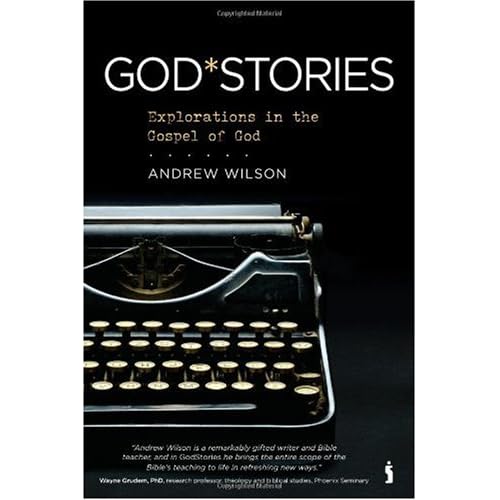
For a wonderfully clear and engaging use of story to communicate God's big story, do get hold of Andrew Wilson's God*Stories. I'm using it for church teen Bible class - but honestly anyone would benefit from it. Top writing, clarity, systematic & Biblical theology, in short chunks using Biblical stories. And that doesn't quite convey it. I picked up a colleagues copy when I was manning a stall at a summer youth festival last summer - and couldn't put it down, so that he lost it for the week, and I then bought several for myself and others.

Tuesday, 18 May 2010

Quote of the Day: A new kind of ending

Dr Jeremy Begbie:
Death, of course, is the reality hovering over everything I've been saying. The ending of all endings. The reality which threatens every hope in a rich ending. The reality which makes us hesitant about hoping for anything too strongly. But this is how God gets our attention. He meets us here, where human false hopes meet their abyss, where all purely human hopes have died.

But from here also, a fresh kind of hope emerges. Three days pass, and the followers of Jesus find themselves with a new kind of hope, in a new kind of ending. Rumours of an empty tomb, and then the man himself, nailmarks in his side & hands, alive, newly alive, more alive than before. What kind of ending can they now look forward to?

Here is an ending we don't create but God gives.
Dr Begbie continues about the ending which breaks in in the middle and transforms. If you care anything for music or theology, watch The Sense of An Ending, below, and hear how the Christian life should be something like playing second violin in the middle of an improvising orchestra. Powerful and informative.

Monday, 26 April 2010

Quote of the Day: Pursuit of perfection

Particularly for preachers, pastors & pastors-in-preparation - but the rest of us, too. Because God has said, 'No one who abides in him keeps on sinning.' [1 John 3.6] Pursuit of perfection?
Any pursuit of perfection that is not awash in the grace of God displayed on a little hill outside Jerusalem is bound to trip us up.
Read more from Don Carson in the latest Themelios (issue 35).

Wednesday, 21 April 2010

Quote of the Day: Un-messianic sense of non-destiny

The West worships the individual; from the cradle to the grave it tells us all how special and unique each of us is, how vital we are to everything, how there is a prize out there just for us. Well, the world turned for thousands of years before any of us showed up; it will continue turning long after we've gone, short of the parousia; and even if you, me, or the Christian next door are tonight hit by an asteroid, kidnapped by aliens, or sucked down the bathroom plughole, very little will actually change; even our loved ones will somehow find a way to carry on without us. We really are not that important. So let's drop the pious prayers which translate roughly as `Lord, how can a special guy/gal like myself help you out some?' and pray rather that the Lord will grow his kingdom despite our continual screw ups, that he will keep us from knocking over the furniture, and that, when all is said and done, somehow, by God's grace, we will finish well despite our best efforts to the contrary.
-
From Carl Trueman, An Unmessianic Sense of Non-Destiny, Reformation 21 (April 2010). Read the whole article for mid-life crisis reflections on the individual, destiny and church.

Thursday, 26 November 2009

Quote of the day: Not because of me

"Look, don't believe in Christ because I'm a marvelous person with wonderful experiences and morality. Look at Christ, because you and I both are so sinful and so prone to evil that we need a Saviour."
- Michael Horton, in
an interview with Christianity Today which is well-worth reading.

Monday, 9 November 2009

Quote of the day: God for scumbags

An unusual source for today's quote of the day: from the News Quiz on Radio 4 -
God spends all his time hanging around prisons waiting for scumbags to find him."
Spot on, in so many ways! But there are a great many more prisons around than he might have meant - people trapped in povery, in oppression, in despair, in consumerism... And not only external forces imprison us: everyone becomes a prisoner to the desires to which we give in [2 Pet.2.19] And we all know how that works - they're not our most wonderful, selfless, godly desires! If we're honest, those things aren't just us on a bad day - they're the emprisoned us spilling out when unguarded. We're emprisoned and we're scumbags.
So the good news! "God spends all his time hanging around prisons waiting for scumbags to find him." Or as God said through a poet a long time before the News Quiz was recorded:
"You who seek God, be encouraged, for the LORD hears the needy and does not despise his own people who are prisoners." Psalm 69.32-33
How come? Does it seem a bit strange of a holy God to hang around our sordid prisons, our hearts which fester, our minds which leak scum, so that we could find him? And who would want to find God in such a state?? Wouldn't we rather run away and hide from God if we're in that condition?!

Ah, but when God came to earth, it turned out that he'd rather emprison himself, absorb all our filth and take the whole sentence himself, to set this scumbag prisoner free. That's not just a God who hangs out around prisons vaguely hoping someone might find him. That's the God who moved heaven and earth to break into the prison and rob it of all its prisoner scum. This is the God who lived perfectly as a man in order to take away our prison uniform and give us his own clothes to wear. Here is the God whose Son agreed to be murdered so that his murderers could be adopted as sons.

I worship that God, not a holy philosophy for people with uncharacteristic moments of weakness, but the God and Father of our Master Jesus who came [as Mark recorded]
'not to be served but to serve, and to give his life as a ransom for many.'
The God revealed in Jesus explodes the walls of our inner hatred and self-reliance, plunders the prison, and takes us as free prisoners of Jesus. Our old prison ID is gone. There weren't multiple new IDs available, though: just the One. So from now on, it's not prisoner #57829. It's Jesus. If I'm free in the presence of the kind of God who hangs out round prisons looking for scumbags like me, it's because he's given me Jesus' identity. Hallelujah!

Wednesday, 28 October 2009

Quote of the day: The unknown God

The christological question, as to whether the statement 'Jesus is God' is true, and if so in what sense, is often asked as though 'God' were the known and 'Jesus' the unknown; this, I suggest, is manifestly mistaken. If anything, the matter stands the other way around.
- N T Wright, Preface, The New Testament and the People of God.